
 Call Us Now
 8010 44 St SE Calgary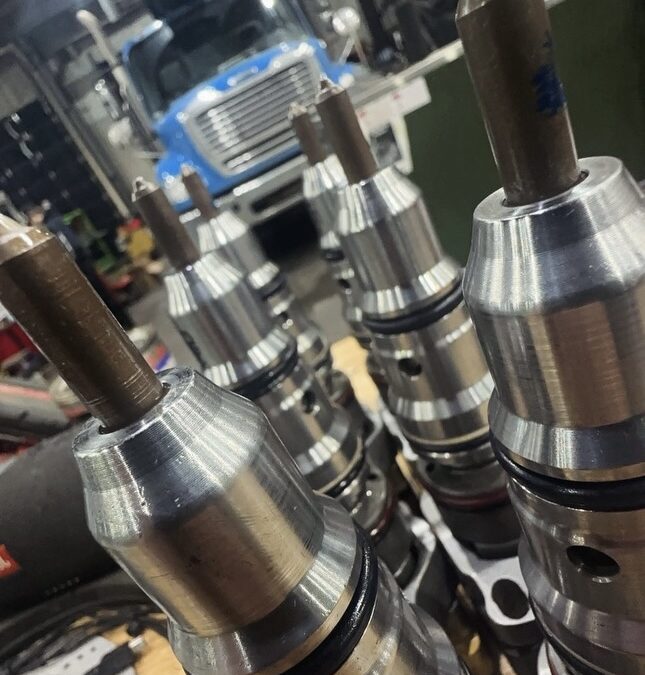
There’s a version of this topic that gets written the same way every time — a definition of fuel injection, a list of components, a section on ‘signs your injectors need attention.’ You’ve probably read it. It’s not wrong, exactly. It’s just not that useful when you’re trying to figure out why your truck is down on power or burning more fuel than it was six months ago.
So let’s skip the textbook version. At Brandell Diesel, we deal with fuel injection systems on working trucks every day — not test vehicles, not showroom units, but trucks hauling loads in Calgary traffic and running long stretches of highway in Alberta winters. What follows is what we actually see.
What the Injection System Is Doing — and Why It’s Harder Than It Sounds
The simple answer is that fuel injection puts diesel into the combustion chamber. The more accurate answer is that it puts a precise quantity of diesel, atomized to a fine mist, at a specific pressure, at a specific moment in the piston’s cycle, and it does this hundreds of times per minute in each cylinder.
That timing and pressure combination is where everything starts. Diesel doesn’t ignite from a spark — it ignites from the heat generated by compression. So if the fuel arrives too early, it’s fighting against the piston. Too late, and the combustion event is weak and incomplete. The margin for error is measured in degrees of crankshaft rotation.
Modern electronic injection systems handle this through the ECM, which reads throttle position, engine load, coolant temperature, ambient air pressure, and a handful of other inputs, then adjusts injection timing and duration accordingly. The system is sophisticated enough that small faults can hide for a while — the ECM compensates. But compensation has a ceiling, and when you hit it, performance drops fast.
Not All Injection Systems Are the Same
Common rail direct injection is what most modern diesel trucks use. A high-pressure pump charges a shared fuel rail continuously — typically between 1,600 and 2,500 bar depending on the system — and individual injectors draw from that rail on demand. Multiple injection events per combustion cycle are possible, which is part of why modern diesels are quieter and cleaner than older ones.
Unit injector systems, found in some Cummins and older VW diesel applications, combine the pump and injector into a single unit per cylinder. Pressure is generated at the injector itself rather than in a shared rail. These systems can hit very high pressures, but when they fail, they’re expensive to address.
Pump-line-nozzle systems are older technology. Simpler mechanically, less precise, still found on heavy commercial equipment and older fleet trucks. They’re more forgiving to work on in some ways, but diagnostics require a different approach.
Knowing which system is in your truck isn’t just trivia. It changes what can go wrong, how it’s diagnosed, what parts cost, and how long a repair takes.
The Connection Between Injection and Power
When an injector wears, the spray pattern degrades. Instead of a fine, even cone of atomized fuel, you get an irregular mist — larger droplets, uneven distribution across the combustion chamber. Some of the fuel burns cleanly. Some of it doesn’t.
The result is uneven combustion, which shows up as reduced torque, rough running under load, and eventually measurable power loss. The frustrating part is that it happens slowly. A truck that’s down 15% on power from worn injectors often doesn’t feel dramatically different day to day — the driver adapts without realizing the truck has changed.
Injection timing drift does something similar but faster. When timing is off by even a few degrees — whether from a sensor fault, a worn pump, or calibration drift in the ECM — combustion efficiency drops sharply. You might hear it as a knock at cold start. Under load, it shows up as sluggishness.
Fuel Economy Is Usually the First Thing That Suffers
Injectors that are partially clogged force the ECM to extend injection duration to maintain requested power. The engine gets the fuel it needs, but less of it burns where it should. The rest exits through the exhaust — either as black smoke or as elevated particulate emissions that most people don’t see but the DPF does.
A stuck-open injector is the other end of the problem. The cylinder is getting more fuel than it can combust, which wastes fuel directly and can wash cylinder walls with unburned diesel — bad for rings, bad for oil contamination.
Neither of these faults is immediately catastrophic. Both will quietly increase your fuel bill while they’re happening. On a truck doing 40,000 kilometres a year, even a 7% efficiency loss adds up to real money by the end of a season.
What’s Happening With Your Emissions — and Your DPF
The DPF collects the particulate matter that incomplete combustion produces. It burns that collected soot off during a regeneration cycle — a process that requires the exhaust to reach a specific temperature, which requires the injection system to add a post-injection fuel shot to raise exhaust temps.
If the injectors aren’t functioning properly, regen either doesn’t complete or doesn’t trigger at all. The DPF loads up. Eventually it restricts exhaust flow, which hurts performance and can trigger a fault code. A full DPF replacement is not a cheap afternoon.
For trucks in Alberta where emissions testing applies, an injection system that’s causing incomplete combustion is often why a vehicle fails. The test isn’t catching a broken part — it’s catching the output of one.
Symptoms Worth Taking Seriously
Hard starts on cold mornings get blamed on glow plugs more often than they should be. Glow plugs help the combustion chamber reach ignition temperature — but if the injection system isn’t delivering fuel correctly, the engine still won’t start cleanly even with working glow plugs.
Black smoke under load is usually an over-fueling issue or timing that’s running late. White or grey smoke at idle often points to fuel that isn’t burning — low compression can cause this, but so can low injection pressure from worn injectors or a weak pump.
Intermittent power loss — the truck that pulls fine most of the time but falls flat on a hill or under heavy load — is often a single injector that’s marginal. It performs adequately at light duty but can’t keep up when the engine needs maximum output from every cylinder.
None of these symptoms should wait. The longer an injection fault runs, the more the engine adapts around it, and the harder it becomes to untangle what’s primary and what’s secondary damage.
What Good Maintenance Actually Looks Like
Fuel filter replacement is the most underrated injection system maintenance item there is. A clogged filter starves the pump, which accelerates wear and reduces pressure. Most diesel manufacturers recommend replacement every 30,000 to 50,000 kilometres. In dusty or dirty operating environments, more frequently.
Injector cleaning intervals depend on the system and operating conditions. High-quality diesel fuel from reputable stations makes a real difference — contaminated fuel and water ingress are two of the most common causes of premature injector wear we see.
Fuel additives are a mixed bag. Some help maintain injector cleanliness in lower-quality fuel. Most are not a substitute for servicing a system that already has problems.
Why Diagnostics Matter as Much as the Repair
Modern common rail injection systems operate at pressures that would be dangerous to work around without proper equipment and training. This isn’t a job where a generic code reader and a best guess will get you far.
At Brandell Diesel, we read injector contribution data to see exactly how much fuel each injector is delivering relative to what the ECM is commanding. We look at fuel trims, injection timing accuracy, and pressure retention under load. For trucks where performance is the question, we use dyno testing to measure actual output and find where it’s being left on the table.
The difference between catching an injector problem at 80% function and catching it at 50% function is often the difference between a cleaning and a replacement — and sometimes between a single injector and collateral damage to the pump or fuel rail.
The Bottom Line
Fuel injection is not a peripheral system. It is the system. Power, economy, emissions, and engine longevity all depend on it working correctly — not just working, but working precisely.
If your truck is showing any of the symptoms described above, or if it’s been a while since anyone looked at the injection system properly, it’s worth having it checked before the problem gets expensive.
Call us at 403-271-0101 or book online at brandelldiesel.com. We’ll run a proper diagnostic and tell you exactly what’s happening — no guesswork, no unnecessary upsells.
Frequently Asked Questions
Q1: How do I know if my injectors need cleaning versus full replacement?
Cleaning makes sense when injectors are fouled but mechanically sound — flow rate is low, spray pattern is off, but the injector body and nozzle aren’t physically worn or damaged. Replacement is needed when the injector can’t hold pressure, the solenoid is failing, or the nozzle tip is eroded. The only way to know which situation you’re in is to test the injectors properly — flow bench testing or electronic contribution testing gives you actual data rather than a guess. At Brandell Diesel, we test before recommending either option.
Q2: Can bad fuel really damage my injection system, or is that overstated?
It’s not overstated. Water in the fuel is one of the most common causes of injector damage we see — even small amounts accelerate corrosion on the precision internal surfaces of modern high-pressure injectors. Contaminated fuel with particulate matter bypasses filter media when filters are overdue for replacement and scores the pump and injector internals. Diesel quality also varies by season; winter blends have different lubricity characteristics that affect pump wear. Using reputable fuel sources and replacing your filter on schedule is genuine protection, not just routine maintenance theatre.
Q3: My check engine light isn’t on but the truck feels sluggish. Could it still be an injection problem?
Yes, and this is common. The ECM sets fault codes when a reading falls outside its programmed thresholds — but a gradually degrading injector can stay within those thresholds while still delivering less fuel than it should. The ECM compensates, no code gets set, and the driver adapts to the reduced performance without noticing how much has changed. Injector contribution testing catches this because it measures actual delivery against commanded delivery, not just whether a value has exceeded a limit. If something feels off, trust your experience with the truck.
Q4: How long do diesel injectors typically last?
In good operating conditions with quality fuel and proper filter maintenance, modern common rail injectors can last 250,000 kilometres or more. In heavy-duty applications, dusty environments, or where fuel quality is inconsistent, 150,000 kilometres is more realistic. Unit injectors in older engines often have shorter service lives and higher replacement costs. The honest answer is that there’s no universal number — operating conditions and maintenance habits matter more than mileage alone. We’ve seen injectors fail at 80,000 km in abused trucks and run cleanly past 300,000 km in well-maintained ones.
Q5: Is it worth having injection diagnostics done as a preventive measure, or should I wait for symptoms?
Preventive diagnostics make financial sense on trucks with high mileage or trucks that are doing serious work. We can run an injector contribution test and pressure checks in a fraction of the time it takes to replace a pump or injector after damage has occurred. If you’re running a truck commercially — deliveries, construction, hauling — unplanned downtime costs more than a diagnostic appointment. For personal trucks, it’s a judgment call, but if you’re past 150,000 kilometres and haven’t had the injection system looked at, it’s not a bad idea to know where things stand before a problem finds you.